An A100 in disguise
NVIDIA launched the CMP 170HX in September 2021, at $4,299, for one job: mining Ethereum. Under its passive heatsink sits GA100, the same chip as the A100 data-center GPU, paired with fast HBM memory. To make sure it could never compete with the A100, NVIDIA locked almost everything else down.
Every stock CMP 170HX runs 5 of the chip’s 8 clusters (GPCs): 35 TPCs, 70 SMs, 4,480 CUDA cores and 280 tensor cores. The full GA100 die has 128 SMs, and even the A100 ships with 108.
Active SMs on the GA100 chip
The SM count was only the start. The other locks:
- Math throttled: the SMs ran at 1/32 of their normal math rate. FP32 fused multiply-add managed about 0.39 TFLOPS and FP64 about 0.18 TFLOPS, and the tensor cores were held back with them.
- Memory hidden: cards shipped with 8 GB of HBM2e (SK Hynix) or 10 GB of HBM2 (Samsung), while the memory on the board holds far more.
- PCIe starved: the link ran at PCIe 1.0 x4, about 0.85 GB/s, and the capacitors for the unused lanes were left off the board.
| CMP 170HX (stock) | A100 PCIe 40 GB | |
|---|---|---|
| Chip | GA100 | GA100 |
| Active SMs | 70 | 108 |
| CUDA / tensor cores | 4,480 / 280 | 6,912 / 432 |
| Memory | 8 GB HBM2e or 10 GB HBM2 | 40 GB HBM2 |
| FP32 (FMA) | ~0.39 TFLOPS, throttled | 19.5 TFLOPS |
| PCIe | 1.0 x4 | 4.0 x16 |
| Cooling | Passive | Passive |
Once Ethereum left proof-of-work, that job was gone. Before this year’s unlocks, used cards sold for around $250 on eBay.
Why Pearl changes everything
Pearl (PRL) went live on April 27, 2026. Instead of pure hashing, it secures its chain with what it calls proof-of-useful-work (NoisyGEMM): miners multiply large matrices of int8 numbers on the GPU, with noise added from a hash of the matrices, then hash the result. When that hash meets the difficulty target, the miner sends it with a short proof that is cheap to check.
That makes tensor-core throughput the number that matters for a Pearl miner. A card with throttled tensor cores had little to offer, until someone found a way to lift the throttle.
How a Pearl share is made
- 1Pick matricesint8 numbers, A and B
- 2Add noisefrom a hash of A and B
- 3Tensor coresmultiply A × BFaster with the unlock
- 4Hash the resultcompare it to the target
- 5Send a proofquick to verify
The locks come off
- June 2026Research paperthe locks can break
- July 12Full-rate computeand tensor cores
- July 14cmpunlockergoes public
- July 18Hidden memory64 GB / 40 GB
- July 24PCIe Gen 2a faster link
- This week110 to 120 SMsdepending on the chip
Full-rate compute and tensor cores
In June 2026, researcher Jon Pry published A Canary in the Crypto Mine: Defeating Stack Protection in a GPU Secure Coprocessor. It showed that all three commercial restrictions on the CMP 170HX (the SM math rate, the memory capacity and the PCIe link) can be defeated in software from a rooted host: no signing key, no debug fuse and no physical access, by running code in the GPU’s “Heavy Secure” Falcon mode.
The community turned that into tools within weeks. On July 12 the compute throttle came off at full rate. The change is written into the GPU’s always-on power domain, so it survives a GPU reset. Two days later cmpunlocker went public. Measured on unlocked cards, FP32 went from about 0.4 to 12.5 TFLOPS, FP64 from about 0.2 to 6.2 TFLOPS, and INT8 on the tensor cores, the math Pearl uses, from 1.6 to about 335 TOPS.
The hidden memory
On July 18 the memory followed. The memory on these boards was never really 8 or 10 GB; most of it was fenced off.
| Card | Stock | Unlocked |
|---|---|---|
| 8 GB (SK Hynix HBM2e) | 8 GB | 64 GB (stability varies by card) |
| 10 GB (Samsung HBM2) | 10 GB | 40 GB, stable (80 GB shows up but fails above 40) |
That turned a $250 mining card into a 64 GB accelerator, and the market noticed: within weeks, eBay listings jumped to $1,200 to $2,000 and more.
PCIe
On July 24 the link moved from Gen 1 to PCIe Gen 2. The full x16 width also needs a hardware mod to add the missing capacitors; one modded card has been seen running x16 at about 6.6 GB/s.
This week: 110 to 120 SMs
One lock still held: the SM count. As of late July, the community’s CMP 170HX wiki still listed “more than 70 SMs” under what you do not get.
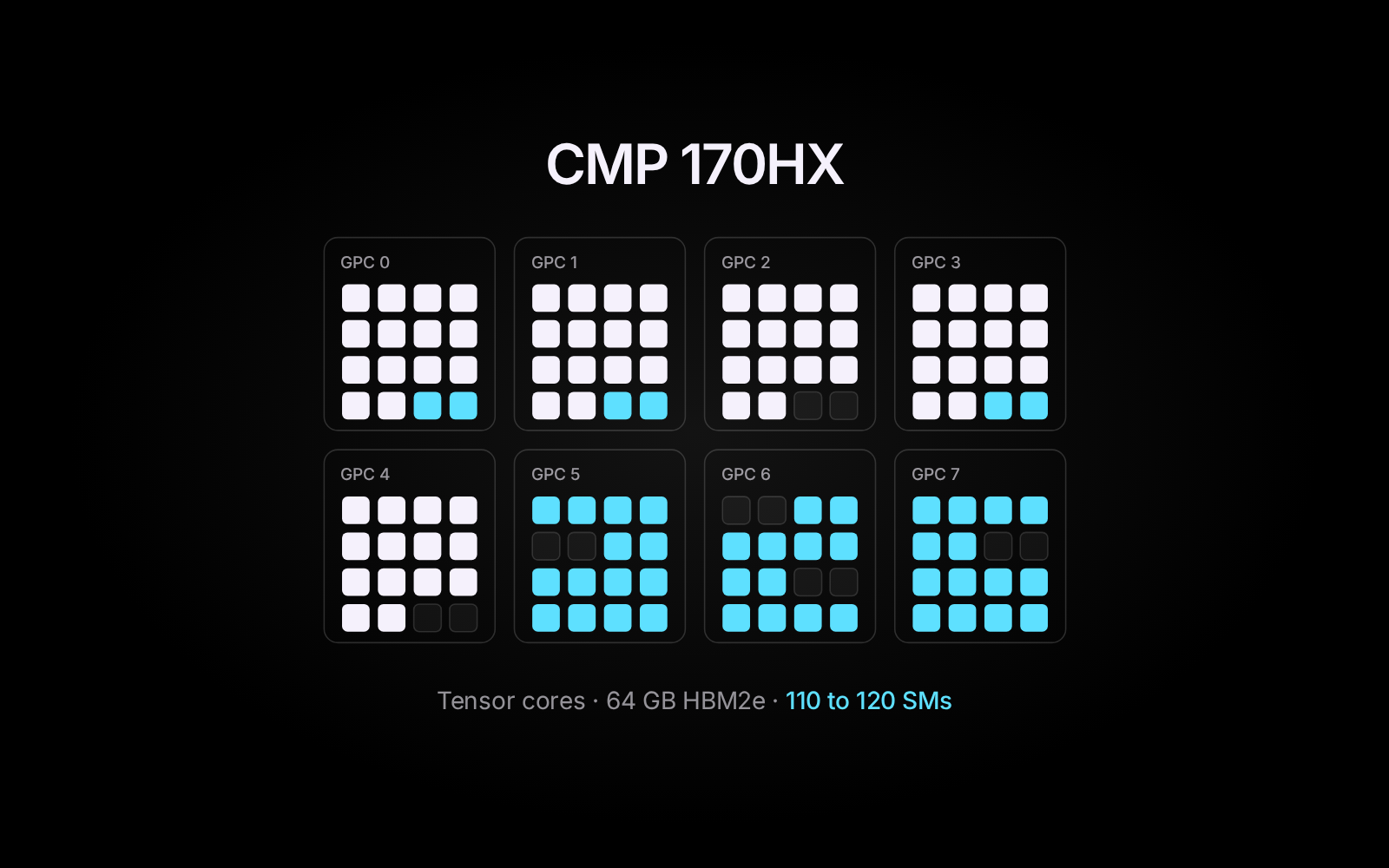
This week that changed. The latest unlock, shared on the JETSKI Discord, re-enables the clusters that were switched off at the factory. Cards now report 110 to 120 active SMs, depending on the health of each chip’s clusters: defective units stay disabled, so every card lands on its own number.
Stock
5 of 8 GPCs, 70 SMs
Unlocked, this week
Example chip: 116 SMs (110 to 120 by chip)
- SM active at stock
- SM re-enabled by the unlock
- SM off: fused off or defective
That puts an unlocked CMP 170HX above the A100’s 108 SMs. On paper, INT8 tensor throughput grows with the SM count:
| Active SMs | Dense INT8 tensor peak (theoretical, 1,410 MHz) |
|---|---|
| 70 (before this week) | ~404 TOPS |
| 108 (A100) | ~624 TOPS |
| 110 | ~635 TOPS |
| 120 | ~693 TOPS |
In practice, power and clocks decide how much of that shows up. On a JETSKI test card with 120 SMs, Pearl hashrate reached 237 TH/s at 250 W, against 150 to 170 TH/s for a card with 70 SMs.
Mine Pearl on PEARLSKI
Start mining on PEARLSKI, the pool with the most optimised CMP 170HX kernel.
Sources
- Jon Pry, A Canary in the Crypto Mine: Defeating Stack Protection in a GPU Secure Coprocessor (June 2026)
- CMP 170HX community wiki and cmpunlocker
- All GB/s without FLOPS: Nvidia CMP 170HX review
- Unlocking the CMP 170HX: how to get 64/80 GB of memory (bytwork)
- CMP 170HX launch date and price (Technical City)
- CMP 170HX prices after the unlock (Wccftech) and the memory unlock on a $250 card (Tom’s Hardware)
- Pearl (PRL), explained (Hashrate Index) and a study of Pearl’s mining protocol (arXiv, June 2026)
- PEARLSKI Mining Pool/Miner